
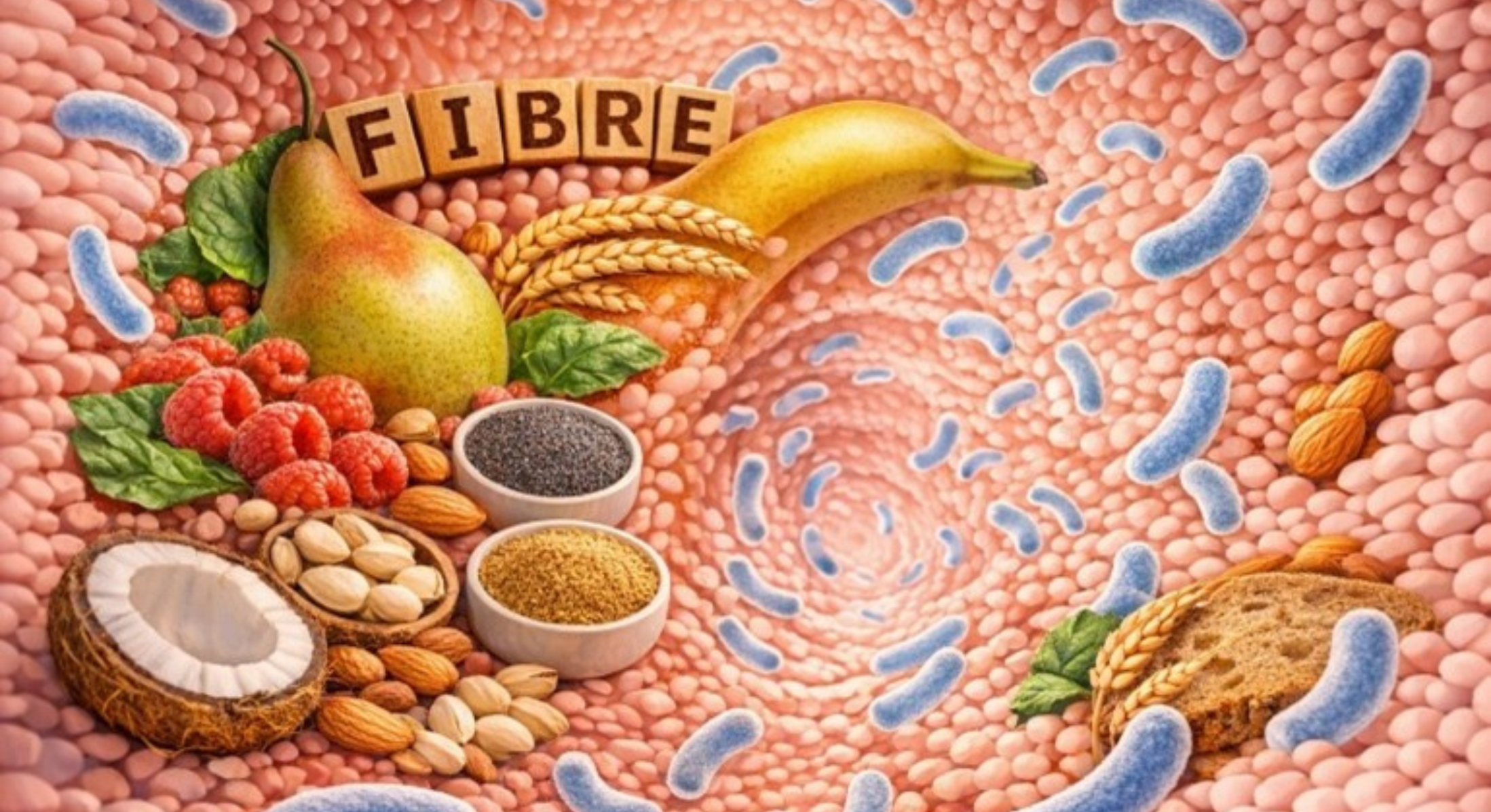
Created with Microsoft CoPilot from images with open creative licenses.
Unknowns on the benefits of dietary fiber in celiac disease
Due to the relatively low microbial biomass in comparison to the colon, the small intestine has for many years received far less attention as a site of meaningful microbial activity. This gap is particularly relevant in celiac disease (CeD), a common inflammatory condition that affects the small intestine and that has autoimmune features. In genetically susceptible individuals, dietary gluten drives a T cell-mediated immune response that damages the lining of the small intestine. The inflammatory reaction impairs nutrient absorption and can lead to a wide range of gastrointestinal and extraintestinal symptoms1. In preclinical models, the severity of immune reaction to gluten is modulated by enteric infections as well as the presence and activity of the gut microbiota2.
The only available treatment for celiac disease remains a strict, lifelong gluten-free diet, which can be costly, socially restrictive, and nutritionally inadequate, such as low in fiber. Once the disease is diagnosed, which can take many years to occur, patients are frequently advised to increase their fiber intake through diet or supplements to help manage symptoms such as constipation3. However, the rationale has always been to stimulate colonic microbial function, and whether fiber supplements affect the low biomass microbial environment of the small intestine, the main site of mucosal lesion in celiac disease, has remained unclear.
Why patients with celiac disease might not benefit from fiber alone
While many patients with CeD are advised to eat more fiber, a new study from Mark Wulczynski and colleagues suggests that the benefits of boosting fiber intake may depend on whether the right bacteria are present in the gut to break it down. By examining microbial activity directly in the small intestine, the researchers provide evidence that the benefits of fiber in CeD may depend not only on the intake amount, but also on the presence of specific microbial communities capable of metabolizing fibers into SCFAs4.
The study, led by Mark Wulczynski and Dr. Elena Verdu at Farncombe Family Digestive Health Research Institute, McMaster University, set out to examine microbial activity directly in the small intestine, an area that has been difficult to study in humans.
To do this, the team analyzed samples from the duodenum of three groups: individuals with newly diagnosed CeD still consuming unrestricted diets, treated patients who were following a gluten-free diet for at least two years, and non-celiac controls consuming unrestricted diets. This approach allowed the researchers to move beyond stool-based analyses and capture microbial function in the small intestine, the site most affected by the disease.
As expected, both disease status and diet shaped the composition of the small intestinal microbiota. But one finding stood out: regardless of whether patients were newly diagnosed or long treated with a gluten-free diet, both groups showed a marked reduction in members of the Prevotellaceae family. This key bacterial family is known for their role in fiber degradation, and their reduced abundance corresponded with a reduction in fiber-degrading enzymes in the duodenum.
Eating less fiber is not the only factor driving microbial deficits in celiac disease
Regulatory bodies such as Health Canada and the European Food Safety Authority set the recommended fiber intake ranges from 25 to 38 grams per day, but most people fall short of that target5,6. For people on a gluten-free diet, the gap may be even wider, since avoiding wheat and related grains can reduce access to common fiber sources. This observation was reflected by patient-completed dietary questionnaires. Most participants, especially those on a gluten-free diet, were estimated to be consuming less fiber than recommended by Health Canada. To test this more directly, the team partnered with Dr. Lawrence David’s group at Duke University to use FoodSeq, a technique that detects plant-derived DNA in stool samples, providing an objective marker of fiber sources in the diet7.
Patients with CeD on a gluten-free diet had the expected dietary shifts toward gluten-free alternative foods such as rice, oats, and nightshade vegetables instead of wheat. However, the analysis indicated that dietary patterns alone could not explain the observed microbial deficits in fiber metabolism. The loss of fiber-degrading microbes and their metabolic functions were already present at diagnosis and did not recover fully with long-term adherence to a gluten-free diet. In other words, removing gluten allowed for disease remission, but did not restore microbial metabolism of fiber.
To explore the functional consequences of this microbial imbalance, the researchers turned to preclinical models. In ex-germ-free mice, they showed that fiber supplementation could increase the production of SCFAs in the small intestine, but only when appropriate microbial groups were present. Without fiber-degrading bacteria, such as those in the Prevotellaceae family, the metabolic byproducts of fiber were almost completely absent.
Not all fibers worked equal and the effect on small intestinal health was also fiber specific. Supplementation with inulin, a well-characterized fermentable fiber, altered the composition and activity of the small intestinal microbiota to accelerate intestinal healing after experimentally induced inflammation in genetically susceptible mice. In contrast, supplementation with Hylon VII, a resistant starch derived from corn, did not reproduce the same healing benefits, despite both being considered prebiotic fibers.
Taken together, the findings suggest that fiber’s benefits depend on both the type of fiber consumed and the metabolic capacity of the resident microbiota, a relationship that may be particularly important in the small intestine for CeD. More broadly, the work highlights a shift toward more personalized approaches in nutrition and medicine, where an individual’s microbial composition may influence how effectively dietary interventions work.
Adding more fiber in celiac disease will not be the solution unless the right bacteria are present
CeD affects an estimated 80 million people worldwide and is treated with a strict lifelong gluten-free diet, which is highly effective at shutting down the immune response to gluten. Despite this, up to 30% of patients remain symptomatic or develop gastrointestinal symptoms over the course of the gluten-free diet. The new findings suggest that supporting nutritional intake during the gluten-free diet may require more than just replenishing missing substrates such as fiber. It may also depend on restoring the microbial functions that convert fiber into health-promoting metabolites. This could involve identifying specific fibers that are more rapidly metabolized in the small intestine, along with fiber degrading probiotics.
As research continues, this work opens the door to more tailored interventions for CeD that complement dietary restriction and toward actively rebuilding the functional ecosystem of the gut.
This research was conducted by the team of Dr. Verdu in the Farncombe Institute Digestive Health Research Institute, at McMaster University. Dr. Verdu holds a Canada Research Chair in Microbial Therapeutics and Nutrition in Gastroenterology and funding from the Canadian Institutes of Health Research #168840. Mark Wulczynski received a J.A. Campbell Young Investigator award from Celiac Canada.
References:
- Abadie V, Han AS, Jabri B, et al. New insights on genes, gluten, and immunopathogenesis of celiac disease. Gastroenterology. 2024; 167(1):4-22. doi: 10.1053/j.gastro.2024.03.042.
- Galipeau HJ, Hinterleitner R, Leonard MM, et al. Non-host factors influencing onset and severity of celiac disease. Gastroenterology. 2024; 167(1):34-50. doi: 10.1053/j.gastro.2024.01.030.
- Pinto-Sanchez MI, Blom JJ, Gibson PR, et al. Nutrition assessment and management in celiac disease. Gastroenterology. 2024; 167(1):116-131.e1. doi: 10.1053/j.gastro.2024.02.049.
- Wulczynski M, Constante M, Galipeau HJ, et al. Small intestinal microbial fiber metabolism dysfunction in celiac disease. Nat Commun. 2026; 17(1):2698. doi: 10.1038/s41467-026-70644-4.
- EFSA Panel on Dietetic Products and Allergies (NDA), N. Scientific Opinion on Dietary Reference Values for carbohydrates and dietary fibre. EFSA Journal. 2010; 8(3):1462. doi: 10.2903/j.efsa.2010.1462.
- Trumbo P, Schlicker S, Yates AA, et al. Dietary reference intakes for energy, carbohydrate, fiber, fat, fatty acids, cholesterol, protein and amino acids. J Acad Nutr Diet. 2022; 102(11):1621-1630. doi: 10.1016/s0002-8223(02)90346-9.
- Petrone BL, Bartlett A, Jiang S, et al. A pilot study of metaproteomics and DNA metabarcoding as tools to assess dietary intake in humans. Food Funct. 2025; 16(1), 282–296. doi: 10.1039/D4FO02656J.